Auto Sorter (loot room)
One intake box, sorted into separate boxes by filter.
Dump a full inventory into one box and let the system deal each category into its own container. This is the first industrial build most people do, and it teaches the two ideas everything else is made of: adaptors and filters.
Before you start: the three pieces
You only need to understand three things.
A Storage Adaptor sits on top of a box. It is the thing that gives a container pipe connections — without one, a box is just a box and pipes have nothing to attach to. It has a Power In port, and power passes through it, but the sorting itself needs no power at the adaptor. Every box in this build gets one, including the intake.
An Industrial Conveyor is what actually moves items. It has an Industrial In side and an Industrial Out side, and it only ever moves items from in to out. It cannot pull from its own output. It costs 1rW to run and it has to be switched on.
A Splitter is a junction. One pipe goes in, three come out. It has no logic, no filter and no power cost — it just lets one path reach three places instead of one, spreading items across the outputs. Nothing moves because of a splitter; something moves because a conveyor is powered and running.
That is the whole vocabulary. A sorter is one intake box, a splitter, and one filtered conveyor per category.
The shape
                      ┌──▶ conveyor (weapons)    ──▶ weapons box
intake box ──▶ split ─┼──▶ conveyor (resources)  ──▶ resources box
                      └──▶ conveyor (components) ──▶ components box
Every conveyor sees everything in the intake. Each one takes only what its filter allows and leaves the rest alone. There is no routing decision being made anywhere — three conveyors are each independently picking through the same box.
That is worth sitting with, because it explains every quirk further down.
Step 1 — place the intake and its adaptor
Put the box you will be dumping into somewhere you can reach it, and put a Storage Adaptor on it.
Step 2 — place the destination boxes
One per category. Adaptor on each. Leave room — this is the part people regret, because adding a fourth category later means finding space next to the other three.
Step 3 — run a pipe from the intake to a splitter
The pipe goes from the intake adaptor to the splitter's input. You now have three outputs where you had one.
If you want more than three categories, chain a second splitter off one of the outputs. Three becomes five (two remaining outputs plus the new splitter's three).
Step 4 — a conveyor per lane
Pipe each splitter output into a conveyor's Industrial In, and the conveyor's Industrial Out into a destination box's adaptor. Repeat per category.
Step 5 — power the conveyors
Each is 1rW. Three lanes is 3rW. Wire them from a branch or a battery, and make sure they are switched on — a wired but off conveyor moves nothing and still occupies its share of a splitter's input.
Step 6 — set the filters
Open each conveyor and add what that lane should take.
A filter slot holds either one item or a whole category. "Weapons" costs one slot. Listing fifteen guns individually costs fifteen. Use a category where one exists.
A conveyor holds 30 filter slots, so you are unlikely to run out — even a lane listing a dozen items by hand has room left.
Why anything unmatched stays in the intake
Nothing sweeps the leftovers. If no conveyor's filter accepts an item, it stays where it is.
That doubles as a leftovers pile, which is useful. But a permanently full intake almost always means a filter is missing rather than the system being broken — go looking for the item that has nowhere to go before you go looking for a fault.
Watch out
- Overlapping filters are unpredictable. The conveyors do not run in a set order, so if two lanes both accept the same item, whichever fires first takes it. Keep the lanes separate.
- One adaptor per box, including the intake. That cost scales one for one with categories and is the one people forget when planning.
- A splitter is three outputs, not more. Chain another off one output for a fourth lane.
- Extending storage happens at the ends. Chaining boxes adaptor to adaptor behind a destination gives that lane more room. It does not change the sorter's shape.
Parts list
| Component | Qty | Draw | Data |
|---|---|---|---|
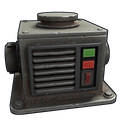 Storage Adaptor Storage Adaptor | 4 | 1rW | Confirmed |
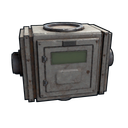 Industrial Splitter Industrial Splitter | 1 | — | Confirmed |
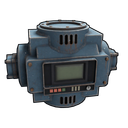 Industrial Conveyor Industrial Conveyor | 3 | 1rW | Confirmed |
Quantities are for the layout shown. Change the size in the designer below and the parts list changes with it.
Watch someone build it
Other people’s videos. Not ours, and not checked against the current patch — but watching the pieces go down is faster than reading about it.
Design your own
Weapons · Resources · Components
Power: 3rW external · 8 parts · throughput 3× conveyor-units
- Anything matching no filter stays in the intake box. That doubles as your leftovers pile, but a permanently full intake usually means a filter is missing rather than the system being broken.
- 1 of these lanes (Resources) have no single in-game category, so each item has to be listed individually. Those lanes eat filter slots much faster than the rest.
- A conveyor holds 30 filter slots, so slots are rarely the limiting factor — even the widest lane here uses a handful. Confirmed in game.